
This week our group finished the first book of the Terra Antartica premium adventure by Edge Studio. Rather than writing session summaries, I decided to discuss each book in a single post. (Unfortunately we had already left the States when the free prelude, Tending to Loose Ends, was released, so this won’t be a part of this post.) This means that if you haven’t played through the adventure yet, I should warn you, that you are entering Terra Spoilerica. Ie. there will be spoilers.
Prelude to the Adventure
As our group wasn’t entirely sure, if we would be able to play through the (about) ten sessions of Terra Antarctica, we started out with the adventure presented in the Core Rulebook, followed with the first adventure of the Arkham Mysteries. I personally think that the Core Rulebook adventure is one (if not THE) of the best adventures in any rpg’s core book. The one from Arkham Mysteries was also pretty good. In any case they both were entertaining enough that our group decided to tackle this premium adventure.
In my 30+ years of gaming, I have never ran a campaign from a published book. And my players know my (lack of) abilities to do so. I usually find it tedious and limiting, and with my challenges of concentration I always feel like I miss something, and it will hinder the adventure’s progress.
That being said, I have actually enjoyed running Terra Antarctica. It’s not a perfect product, but thus far it has been entertaining for me and other players as well. At least that is what they tell me.
Starting the Adventure
The first part of the first book has the investigators recruited to participate in the rescue mission to Antartica. While this part was mostly well written, I found it a bit lacking in terms of player interaction. There’s a lot of ”training montages” and exposition. The investigators just are there, observing the events. This is clearly done to support the narrative of the story and get the investigators to settle in as part of the crew. But still I found myself rushing it a bit, as I was concerned about everybody wanting to set sail and get into the ”good part”.
This approach meant that the players skipped the part of the adventure in which they actually have something to do. There’s a scene in which the investigators might investigate the background of an NPC further, but my players just didn’t take the hook. And I cannot blame them. There’s no reason for their characters to do so. If I would run this adventure again, I think I would guide (or force) them to take on this side quest, as it would make the subplots of the adventure more relevant.
As of now (January 2026) I think this lack of clear causality is one of the key problems of the Arkham Horror adventures. I think that this might be due to writing traditions of Arkham Horror, as in the board and card games the investigators are more likely to pursue every clue anyway. I wouldn’t say that’s impossible in the rpg, but thus far every adventure is written in a way that lacks the clear directions to some part of the adventure. (Hungering Abyss is the most infuriating example of this problem.)
After the summary of the sea journey the investigators arrive to Antarctic. They climbed a mountain and spotted the ship they were looking for. This ended our first session of the adventure with humorous bennyhill-montage of each failing the descent action.
Conquering Antarctic
Our group was eager to continue the adventure and after a bit of a hiatus due to the holiday season we were back in business.
The second session surfaced more and more problems with the writing style of this adventure. I have ran low effort prep games for years, but the first session clearly proved I needed to change my style. I made notes, draw maps, printed out handouts, and still managed to fumble a lot during the investigation of the ship. It’s not that it’s badly written, it’s just that the information is broken in to so many pieces that finding them all is a nightmare.
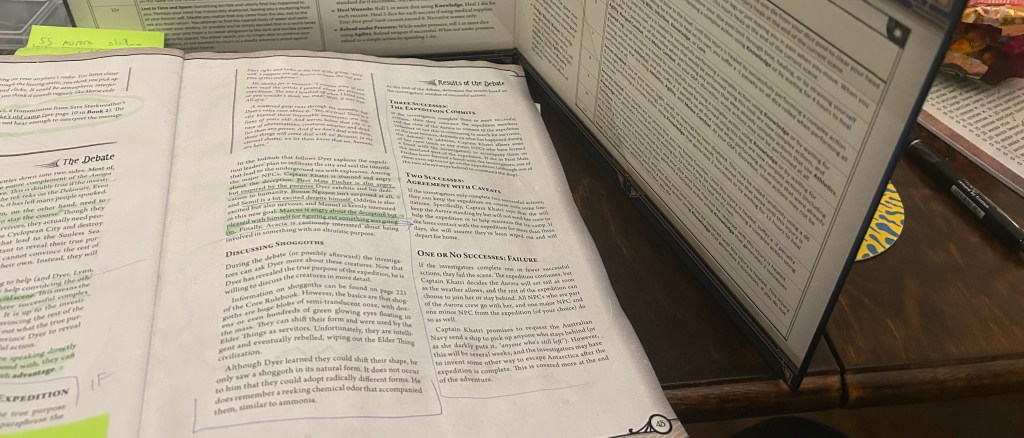
I have no problem of admitting that this just might be my personal headache, but still I would like to have all relevant info a certain location presented in one section.
Another issue I have with Arkham Horror adventures is the lack of maps. I mean there are beautiful combat maps, but everything else is missing. Maybe I have grown accustomed to having the locational maps in adventures, but AH rarely presents them. And in the case of Terra Antarctica they have one of the worst maps I have ever seen.
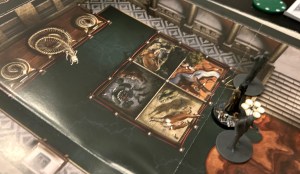
The map of the ship is beautiful. But it is presented in a way that would make Lovecraft proud. The silhouette of the ship is printed in tiny details, but even it is better than the mixed presentation of the ship’s interior. I can understand the need of saving space in a high quality printed product, but the combat map of the ship is just laughable mess. Running the adventure again, I would photocopy it and present each section as a separate piece. But even that wouldn’t remove the problem of the silhouette showing stairs that aren’t present on the combat map (and the map revealing certain story elements in advance).
Even with me struggling with the presentation of this part, my players apparently liked the growing dread. Their descent to the bowels of the ship seemed a bit forced though; I’d advice any GM to add some details to encourage the PCs to delve deeper.
Combat in Arkham Horror
Up until the fight in the ship’s engine rooms, our group had had the idea that Arkham Horror is relatively safe game. Nothing they have faced thus far has provided any challenge, except maybe in a way that the combats take too long (once again I’m looking at you Hungering Abyss). This fight proved we were wrong.
The battle reminded us all of the xenomorphs of Alien franchise, and in a good way. The monsters poured in, and seemed almost unstoppable.
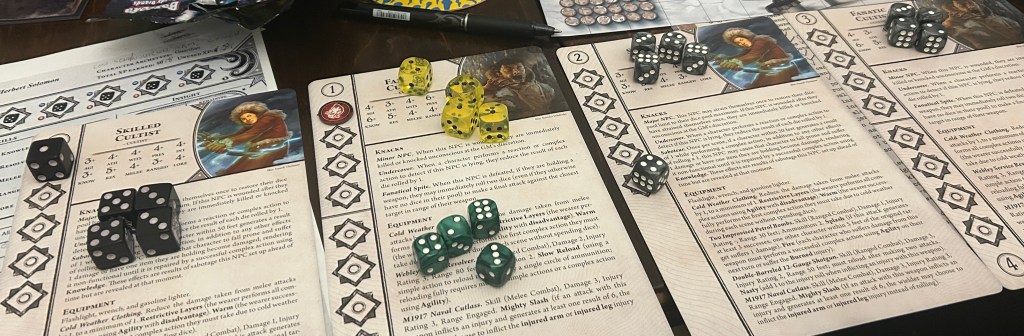
In fact I think there should be an errata for the monsters; the way they are now written implies each investigator should make a Resolve reaction each time they see one of these monsters. With the way they are written this means investigators either loose most of their dice or gain horror (which makes the monsters stronger). I’d encourage to make the reaction only for the first time the investigators witness them during a scene.
Another problem with the monsters is the way they are summoned. As the investigators are likely to have arrived here with a motor boat, new monster (or even monsters) could spawn on the boat while they are returning to the camp. Which might very well lead into a total party wipe in an unnecessary and totally random scene. Once again I find the idea here better than the execution. I think these monsters would make a great stand alone adventure set in Arkham, where they could be explored further.
Extended Out of Action in Antarctica
During the fight I rushed them all against them, not wanting to play each fight scene by scene as presented in the book. This made the fight more intense, and I think it was the right choice. Even if it lead to the problem of Arkham Horror’s injuries. The injury table has been updated from the one presented in Hungering Abyss (if you are using the GM shield provided in it, please take note of this). While it is better, it is by default a bit problematic. My games have seen enough leg injuries to make us retell stories of Cyperpunk 2020 we played in the 90s.
While a little humour in a horror game is all fine and well, it shouldn’t come from the rules. The table isn’t bad, but it should be broader in description. I know I can narrate it the way I choose but during combat I would much rather use tables as is to make them run smoother.
Another problem with the table is the ”lack of sense”-outcome. As a player I would much rather my character to just kick the bucket in this kind of an adventure, than just ”loose hearing for two weeks”. In games set in Arkham this wouldn’t be a problem, as a time skip could be done more easily. But in an adventure where the time is of the essence and a part of the narrative, this is just… well not good.
I asked ideas of how to deal with this in Reddit, but eventually (after discussing with the player) ended up with just giving the player one of the NPCs as a new character. While not optimal, at least this meant that the player had a new character that could participate in the adventure.
Up until our third session, in which that character was badly injured as well.
I’m not entirely sure if Terra Antarctica should have a different Injury-table. But having one wouldn’t hurt. Changing characters in an adventure like this forces the player to adapt constantly find new reasons to tie in their new characters. This isn’t Arkham Horror’s problem though. It’s a price of dangerous adventures set in secluded places. But it would be much easier to accept if the PC was just removed from the game, rather than being unable to participate due to a loss of sense…
Fumbling the Scene Structure
Even with the problems I have presented here, I have to underline that the experience has been far more positive than we anticipated. In fact I was so ready to finish the first book, that I ran the scene out of order by accident. Luckily this mix up didn’t affect things too much. I just ran the discussion about wether the rescue party should leave Antarctica before they had found the advance camp. This meant that I was a bit confused of them learning about the fate of the said camp, but reasoned that it was just something I had forgotten of the previous session.
Once I noticed the error, we had already had some nicely heated conversations and the investigators had already managed to convince everyone to continue the mission. When I told my players about the mix up, they reasoned that it actually worked better this way around. It made the discussion more relevant and based on the actual situation and not the terror presented by the mythos.
It also meant that the first mate was with the PCs when they found the destroyed camp, thus giving him (and his crew) more agency in participating the adventure.
As a side note I must admit that I really like the first mate as an NPC. I feel like he’s written from a very American point-of-view with his communist ideology maybe making him suspicious character. But for our group of Leftists he doesn’t seem that way. In fact he’s a nice counter balance to one of the investigators, who is a devout capitalist door-to-door salesman (a background we all find quite amusing for exploring the Antarctic).
How To Fail Forward?
One of the key problems of investigation games is the balance of the gaming and narrative. How do we get the characters to use their skills for investigation in a way that doesn’t hinder the story. I would say Arkham Horror is certainly an easy game, with failures rarely affecting too much. But when each investigator failed each complex action while studying the remains of the camp, I was a bit frustrated with the option given in the book.
I mean I like the idea of using Insight to cover this kinds of incidents, but should I always offer it as an option? Or could the players ask to use it beforehand?
This is the same problem I have with the Intuition skill which can be used in almost any instance, without actually revealing anything. In this third session I just ignored the prompts to use the skill if the players weren’t asking for it. I’m constantly being teased about trying to fish out the players’ dice, but the results of most Intuition action are just not relevant.
They could be used in a better way, but thus far I haven’t noticed too many ”fail forward”-kind of actions. In a premium adventure I think they should be included, so I wouldn’t have to come up with ideas to progress the story if the players miss the key elements. Especially if some parts of the adventure can be just skipped if the players aren’t that interested.
It Gets Better!
I swear the adventure actually keeps getting better the longer way play it. I hope my criticism hasn’t discouraged any potential GMs. I just wanted to present my ideas on how to improve the adventure, as thus far it has been so close to be an absolute hit. Even as we have played it, the adventure is sure to be remembered in the future. After finishing the first book my players gave a sudden applause for our group for getting through it – and that has never happened before. At least not in my games.
One of the reasons for this must be the final fight of the first book. My investigators were discussing about the events of this mission in their tent (ie. rolling to reduce horror from their characters). No-one had thought of posting any guards, so the fight began a bit on the fly. And in a way the book was unprepared for; we had to skip (again) like a page of the adventure to get into the scene.
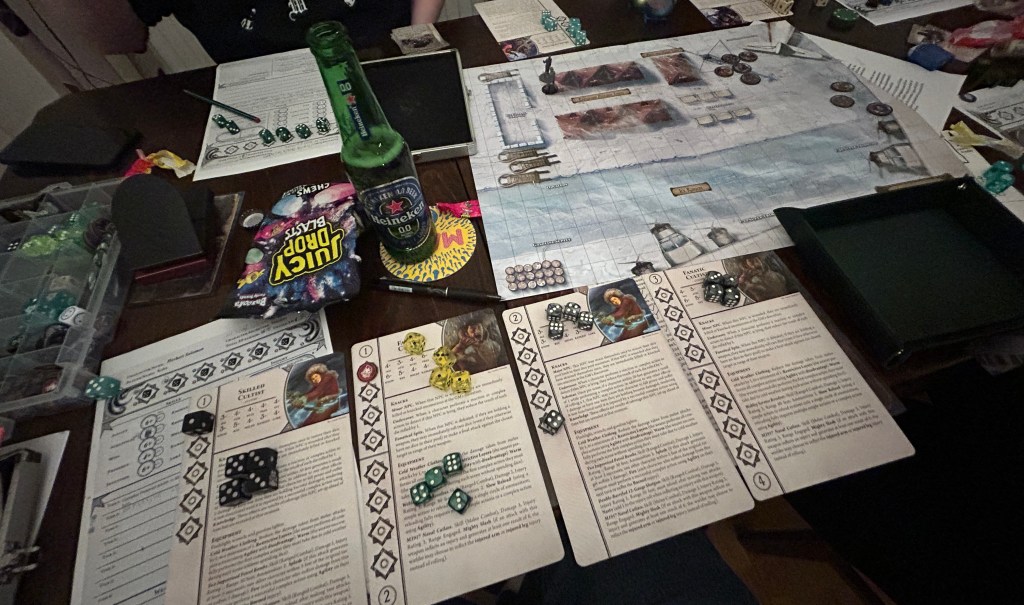
While I was abhorred by the sheer amount of dice and things we had to lay out on the table to run this combat, it ended up running really smoothly. Everybody had something to do with their own characters, and the ally NPCs present at the camp. While the map seemed a bit too simple for my liking at first, it provided enough interactions that the combat was really entertaining.
I usually loathe running long combats, but this proved me wrong and was the final piece that sold the game to me. My horror games have never been about combat and I wouldn’t say that Arkham Horror is that (entirely) either, but I can appreciate a game when it works. And this combat was a blast!
Closing Thoughts
After three sessions of Terra Antarctica it seems like my initial thoughts have been confirmed. The game runs smoothly enough to be interesting and the scenes provided in it can be ran roughly in one hour. Some are a bit shorter, some way longer, but the average time is about the same after each session.
I have read many thought about Arkham Horror being too generous in handing out experience (one per hour of game play), but for our group it hits the sweet spot. We get to play biweekly after work, and usually play about four hours. Reading about players reaching 150exp in a month is just way beyond our scope-though it does remind me of gaming in our teens.
Even with us having not finished the campaign, I would argue we have already gained enough from it to say it was a great purchase. If we would just stop now, there would still be enough cards, and stuff, for me to use in other games of Arkham Horror. Everything that comes after this makes it more and more worth it, so I would definitely encourage everyone still on the fence to buy this. Even if only to support the Edge Studio’s plans to publish more stellar products like this.
Stay tuned for the next part of our play-through – even though it will take us some time to get through the second book I’m confident we’ll get there.

 Diceblastes
Thanks for the amazing write up! Very critical but also very revealing and clearly stating your viewpoint. I am looking forward to my game of Terra Antartica. Still have to open the box! 😀
TykkääTykkää
Thanks! It’s always great to hear someone has read these ramblings. ^_^ It really motivates to do them.
TykkääTykkää